Cartography glossary for fantasy writers
The vocabulary of maps is small and useful. Knowing the terms helps you decide what your map needs and what it can skip.
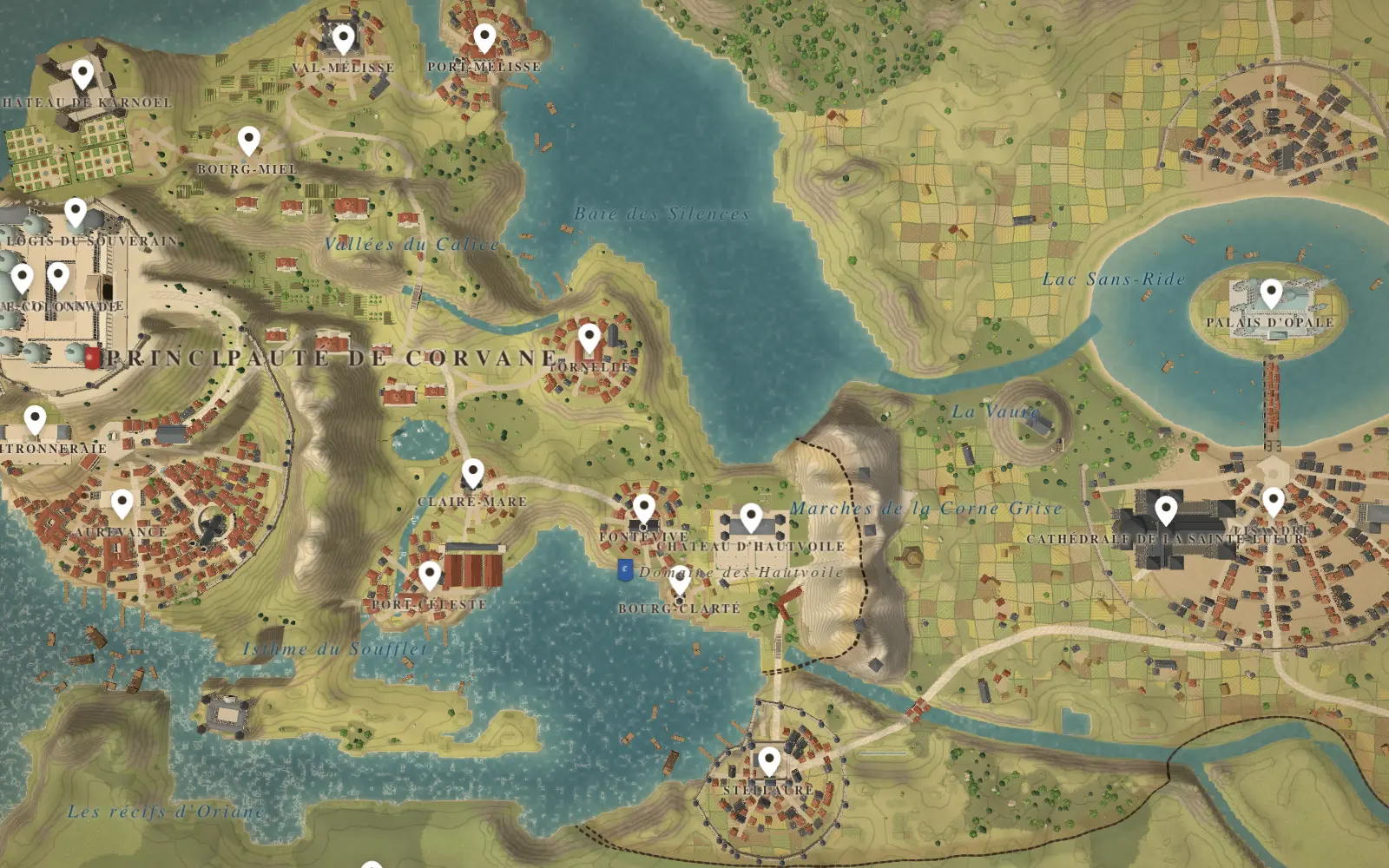
The terms
- Cartouche
- A decorative frame that holds the title, the scale or the legend. Common on old maps, it gives a fantasy map an antique look.
- Compass rose
- A symbol showing the cardinal directions, and on many old maps the intermediate ones too. It tells the reader where north is. If you leave it out, put north at the top.
- Contour line
- A line joining points of equal height. Lines that sit close together mean a steep slope. Contour lines on a fantasy map suggest relief without drawing every hill.
- Elevation
- Height above sea level. Rivers flow from high elevation to low.
- Gazetteer
- An index of places with their locations. A list of every place in your world with a short note works as a gazetteer for your own use.
- Graticule
- The grid of latitude and longitude lines on a map. Useful for a world shown as a globe, rarely needed for a regional map.
- Hachures
- Short lines drawn along a slope, closer together where it is steeper. Many printed maps used them before contour lines took over, and they suit a medieval look.
- Here be dragons
- The phrase is often associated with old maps. In fact it is found on very few of them. The Latin hic sunt dracones appears on the Hunt-Lenox Globe, made around 1510.
- Hillshade
- Shading that imitates light falling on the land from one side, which makes hills and valleys look three-dimensional. Also called relief shading.
- Inset
- A small additional map, placed in a corner, that shows a detail or a distant region at another scale.
- Legend
- A list explaining the symbols on a map, also called a key. Add one if you use symbols a reader might not recognise.
- Neatline
- The thin border line around the mapped area.
- Portolan chart
- A medieval navigational chart of coasts and harbours, covered with lines radiating from compass roses. It records coasts in detail and leaves the interior almost blank.
- Projection
- A method of flattening the curved surface of a planet onto paper. Every projection distorts something. For a regional fantasy map you can ignore it, and for a whole globe you should choose one on purpose.
- Rhumb line
- A line of constant compass bearing, drawn on charts to help sailors steer.
- Scale bar
- A graphic that shows how a distance on the map matches a real distance. Unlike a written ratio, it stays correct when the map is resized.
- Terra incognita
- Latin for unknown land. A label for regions that mapmakers had not explored. On a fantasy map it is also an easy way to say that the characters, and the reader, do not know what lies there.
- Toponym and toponymy
- A place name, and the study of place names. See how to name the places on a fantasy map.
Which elements does your map need
- A title, so that the reader knows what they are looking at.
- North at the top, or a compass rose when it is not.
- A scale bar, so that distances can be read and checked.
- Labels for the places your story visits.
- A legend, only for symbols that are not obvious.
- Decoration such as a cartouche or a neatline, if it suits the style of your book.
Decoration is optional and clarity is not. The guide on drawing a fantasy map for your novel puts these elements in the order in which we add them.
Questions
- Does a fantasy map need a compass rose?
- Not strictly. Readers expect north at the top. A compass rose helps when north is not up, or when you want an old look.
- What is the difference between a scale bar and a written scale?
- A written scale such as 1 to 100,000 is only true at the original size. A scale bar is drawn on the map, so it stays correct when the map is enlarged or reduced.